
Recipe calorie
calculator.
List what went into the pot to get calories and macros per serving, per 100 g, and for the portion on your plate. It is an estimate from the values you enter, not a lab analysis.
Rounded to whole calories and 0.1 g. The result is only as good as the values you enter.
How this calculator works
For each ingredient, it multiplies the amount you used by the calories in 100 g of that food:
It adds the ingredients to get the whole recipe, then divides:
Per 100 g = recipe calories ÷ finished weight (g) × 100
My portion = recipe calories × portion weight ÷ finished weight
Protein, carbohydrate, and fat are added up the same way. Ounces and pounds are converted first: 1 oz = 28.35 g and 1 lb = 453.6 g.
A worked example
The starting recipe is banana oat pancakes for two. The amounts are USDA portion weights, and the calories per 100 g come from USDA FoodData Central.
| Ingredient | Amount | Cal / 100 g | Calories |
|---|---|---|---|
| Oats, dry · Oats, regular and quick, dry | 1 cup · 81 g | 379 | 307 |
| Banana · Banana, raw | 2 medium · 236 g | 89 | 210 |
| Egg · Egg, whole, raw, fresh | 2 large · 100 g | 143 | 143 |
| Whole milk · Milk, whole, 3.25% milkfat | ½ cup · 122 g | 61 | 74 |
| Olive oil, for the pan · Oil, olive, salad or cooking | 2 tsp · 9 g | 884 | 80 |
| Whole recipe | 814 | ||
814 ÷ 2 servings = 407 calories per serving. If the cooked pancakes weigh 480 g, that is 814 ÷ 480 × 100 = about 170 calories per 100 g, and a 200 g portion has 814 × 200 ÷ 480 = about 339 calories. The finished weight is an example, not a measurement, so weigh your own batch.
You can also start from one of our recipes. Each opens here with its amounts filled in: banana oat pancakes, berry overnight oats, avocado toast with fried eggs, spinach and feta omelette, shakshuka, peanut butter banana toast, chicken, rice and broccoli bowls, black bean and avocado rice bowls, tuna and chickpea salad, chicken quinoa salad, chickpea and feta salad, chicken and black bean burritos, salmon with sweet potato and spinach, spiced lentils with rice and broccoli, lentil and tomato soup, beef and black bean chili, spaghetti bolognese, honey soy chicken stir-fry.
Where to find calories per 100 g
Start typing an ingredient and pick a suggestion to fill in USDA values for 46 everyday foods. Each suggestion names its state, such as raw, dry, or cooked, and has a page in our food calorie library.
For anything else, use the product’s Nutrition Facts label. If the label gives calories per serving, convert it: calories per serving ÷ serving weight in grams × 100. A sauce with 60 calories in a 50 g serving has 120 calories per 100 g. Our guide to reading nutrition labels shows where to find both numbers.
Weigh ingredients in the state the value describes
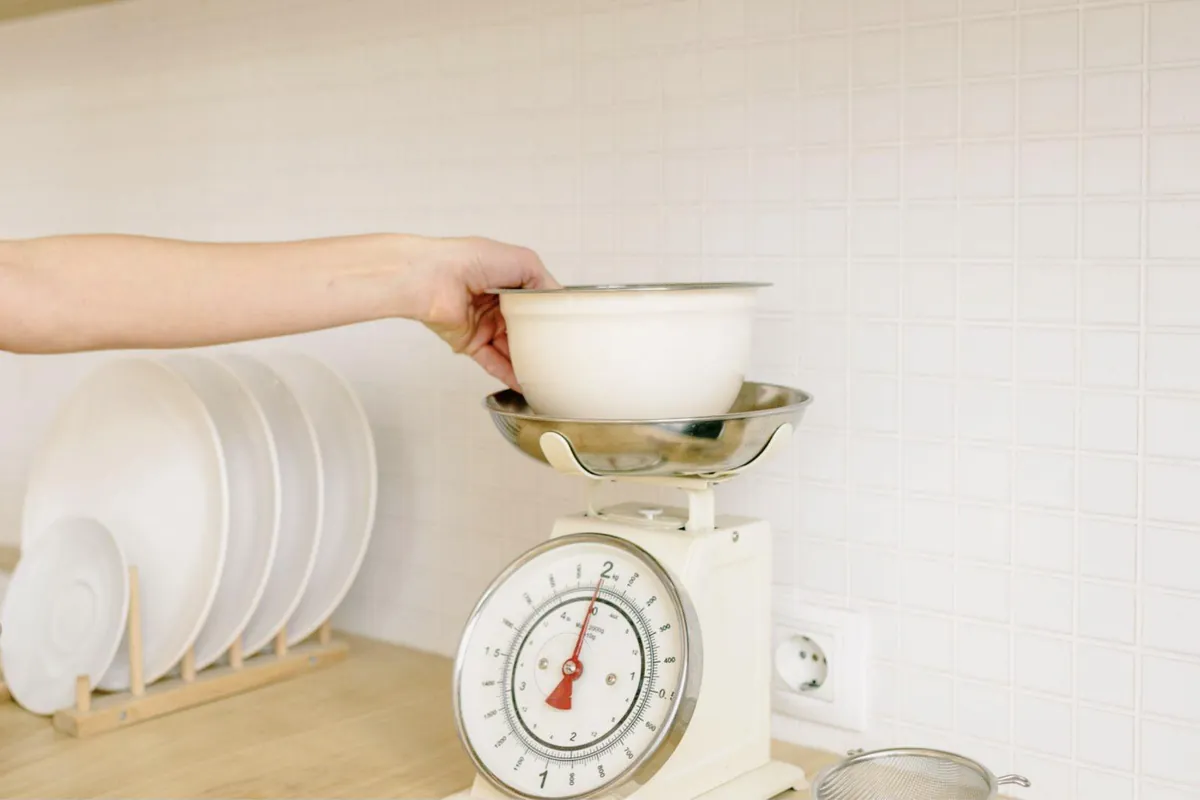
Match each amount to its entry. Dry oats and cooked oatmeal are different entries, and so are dry rice and cooked rice. The rice and pasta suggestions here are cooked, so use them for food you weighed after cooking. For rice or pasta you weighed dry, use the package label. Mixing the two states is the most common way to get a recipe badly wrong.
Per serving or per 100 g?
Dividing by servings works when you split the dish evenly. When portions differ, weigh the finished dish without its container and enter that weight. The calculator then gives calories per 100 g and the calories in a portion you weigh.
Use the finished weight, not the sum of the raw ingredients. The weight changes as food cooks while the calories stay about the same. Our guide to calculating calories in homemade food covers drained fat, leftovers, and other awkward cases.
What the result leaves out
The calculator counts everything you list as eaten. Oil left in the pan, a marinade you pour away, bones, and peels all make the real number lower. It also assumes the ingredients are evenly mixed, which suits a soup or a batter better than a tray of separate pieces.
Save the recipe in Calorify
To keep a recipe and log it by the serving, open the Recipes tab in Calorify, add a recipe, and choose Write it yourself. Enter the servings and the calories, protein, carbs, and fat per serving from this page. The app can also build a recipe from a link or a photo.
Frequently asked questions
How do I calculate the calories in a recipe?
Work out each ingredient’s calories: the amount you used in grams, times its calories per 100 g, divided by 100. Add the ingredients together for the whole recipe, then divide by the number of servings.
Should I weigh ingredients raw or cooked?
Either works, as long as the calorie value describes the same state. Use a dry rice value for rice you weighed dry, and a cooked rice value for rice you weighed after cooking. Mixing the two gives a wrong total.
Does cooking change the calories in a recipe?
Mostly it changes the weight. Food loses water as it cooks, and rice, pasta, and beans absorb it. The total stays about the same unless you add something or throw part of it away, such as drained fat or cooking liquid. That is why calories per 100 g should use the finished weight.
How do I count cooking oil?
Add all the oil you put in. It is easy to forget and adds up quickly: a tablespoon of olive oil (13.5 g) has about 119 calories. If a lot stays behind in the pan, the real number is lower than the result.
Is my recipe saved or sent anywhere?
No. The calculator runs in your browser. Nothing you enter is sent to us or saved, so it is gone when you close or reload the page.
Sources
- USDA FoodData Central (SR Legacy, April 2019) ↗
- USDA FoodData Central: Data documentation ↗
- FDA: Serving size on the Nutrition Facts label ↗
General education, not individualized medical or nutrition advice. See also the macro calculator and the TDEE calculator.
Your next chapter
starts with your next meal.
Make room for a little more awareness. Calorify helps with the rest.
Download on theApp StoreFor iPhone and iPad (iOS 17.6+), Mac with Apple silicon, and Apple Vision Pro